
Betriebliche Dynamiken und Beschäftigungsergebnisse
Firmengründungen und -schließungen sind in einer Marktwirtschaft für die Reallokation von Ressourcen, strukturellen Wandel und damit für die wirtschaftliche Entwicklung von zentraler Bedeutung und spielen vor allem im Hinblick auf die wirtschaftliche Transformation Ostdeutschlands eine zentrale Rolle. Gleichzeitig können die mit dem Strukturwandel verbundenen Arbeitsplatzverluste dramatische Folgen für betroffene Arbeitnehmer haben, wie z.B. Arbeitslosigkeit, Einkommensverluste oder eine geringere Arbeitsplatzqualität. Diese Forschungsgruppe untersucht mithilfe mikroökonometrischer Methoden Gründungen, Wachstumsprozesse und das Scheitern von Unternehmen, die Anzahl und Qualität der von Neugründungen geschaffenen Arbeitsplätze und die Folgen von Firmenschließungen für betroffene Arbeitnehmer und Arbeitnehmerinnen, vor allem in Bezug auf Arbeitsmarktergebnisse wie Beschäftigung und Löhne.
Forschungscluster
Produktivität und InstitutionenIhr Kontakt

- Abteilung Arbeitsmärkte












PROJEKTE
01.2020 ‐ 06.2024
Europas populistische Parteien im Aufwind: die dunkle Seite von Globalisierung und technologischem Wandel?
VolkswagenStiftung
Die Globalisierung hat zwar allgemein den Wohlstand gesteigert, aber in vielen Regionen Europas auch zu Arbeitslosigkeit, Lohnungleichheit, Abwanderung und Überalterung geführt. Das Projekt untersucht, ob diese ökonomischen Lasten zu Wählerstimmen für populistische Parteien führen.
01.2019 ‐ 06.2022
MICROPROD („Raising EU Productivity: Lessons from Improved Micro Data“)
Europäische Kommission
Ziel von MICROPROD ist es, zu einem besseren Verständnis der Herausforderungen beizutragen, die die vierte industrielle Revolution in Europa mit sich bringt. Verliert das Produktivitätswachstum im Kontext von Globalisierung und Digitalisierung an Schwung, und wenn ja, warum?
This project has received funding from the European Union’s Horizon 2020 research and innovation programme under grant agreement No 764810.
07.2018 ‐ 12.2020
Firmenlohndifferentiale in unvollkommenen Arbeitsmärkten: Die Rolle von Marktmacht und industriellen Beziehungen in der Aufteilung der Beschäftigungsrenten zwischen Arbeitnehmern und Arbeitgebern
Deutsche Forschungsgemeinschaft (DFG)
Ziel dieses Projekts ist es, die Aufteilung der Beschäftigungsrenten auf unvollkommenen Arbeitsmärkten und den Einfluss von Arbeitsmarktinstitutionen wie Tarifbindung und betrieblicher Mitbestimmung auf Firmenlohndifferentiale zu untersuchen. Über die Grundlagenforschung hinaus hat das Projekt damit Potential, wichtige wirtschaftspolitische Debatten zur institutionellen Ausgestaltung des Lohnfindungsprozesses zu informieren.
02.2019 ‐ 09.2019
Auswertung des IAB-Betriebspanels 2018 und Erstellung eines Ergebnisberichts für West- und Ostdeutschland
04.2016 ‐ 03.2019
Lohn- und Beschäftigungseffekte von Insolvenzen
Deutsche Forschungsgemeinschaft (DFG)
Ziel des Projekts ist es, erstmals den Prozess und die Folgen des Scheiterns von Unternehmen ausführlich zu analysieren. Insbesondere ist es im Rahmen dieses Projekts erstmals möglich, die Folgen kleinbetrieblicher Insolvenzen zu erforschen, was vor allem deshalb relevant ist, weil Arbeitnehmer in Betrieben mit weniger als zehn Beschäftigten etwa viermal so häufig von Insolvenzen betroffen sind wie Arbeitnehmer in Großbetrieben.
01.2018 ‐ 12.2018
Auswertung des IAB-Betriebspanels 2017 und Erstellung eines Ergebnisberichts für West- und Ostdeutschland
01.2017 ‐ 09.2017
Auswertung des IAB-Betriebspanels 2016 und Erstellung eines Ergebnisberichts für West- und Ostdeutschland
Publikationen
Committing To Grow: Employment Targets and Firm Dynamics
in: Review of Economic Studies, im Erscheinen
Abstract
We study the firm-level and aggregate effects of government-imposed employment targets. We develop a dynamic general equilibrium model with heterogeneous firms and endogenous productivity growth in which penalties for below-target hiring generate a polarization mechanism: low-productivity firms exit, while others expand employment beyond efficient levels, and firms invest in productivity to avoid future penalties. We test and confirm the model’s firm level predictions using unique contractual data on more than 18,000 employment commitments from the East German privatization, exploiting quasi-random variation in the assignment of privatizers to firms. Quantitatively, employment targets reduce unemployment and raise welfare in the short run, but these effects fade as distorted labor allocations and weakened investment incentives slow aggregate productivity growth, leaving no lasting welfare gains. We also evaluate how alternative designs for employment-protection (e.g., the choice between mandates and subsidies, the structure of targets) impact misallocation and the resulting short- and long-run outcomes.
Identifying Rent-Sharing Using Firms’ Energy Input Mix
in: Journal of the European Economic Association, im Erscheinen
Abstract
We present causal evidence on the rent-sharing elasticity of German manufacturing firms. We develop a new firm-level Bartik instrument for firm rents that combines the firms’ predetermined energy input mix with national energy carrier price changes. Instrumental variable estimation yields a rent-sharing elasticity of approximately 0.20, implying that a 10% change in rents leads to a 2% change in wages. Rent-sharing induced by energy price variation is asymmetric and driven by energy price increases, such that, on average, workers do not benefit from energy price reductions but are harmed by price increases. Reduced-form evidence shows that a 10% increase in firm-level energy prices depresses firm-level wage growth by 0.34%.
Grants Versus Loans: The Role of Financial Aid in College Major Choice
in: Economic Journal, Vol. 136 (679), 2026
Abstract
We analyse whether financing higher education through student loans or grants affects the college major choices of students in Chile where either type of financing is allocated based on a standardised test. Students who are marginally eligible for grants are more likely to enrol in high-paying fields such as science, technology, engineering and mathematics. Complementing the reduced-form results, we estimate a discrete choice model on data for narrowly defined higher education programmes. The results indicate that, holding other programme characteristics constant, grant recipients place higher value on fields with high earnings growth potential, while being less concerned about a lower graduation probability.
Monopsonistic Labour Markets
in: German Economic Review, Vol. 26 (4), 2025
Abstract
The three articles in this special issue on “Monopsonistic Labour Markets” provide novel insights on how to model the reasons for employers’ monopsony power, how to measure it, and how much of it materialises in lower wages. We are confident that the studies published in this issue will be of high interest to specialists and a broader audience of economists alike. They definitely deserve a wide readership, and our not unwarranted hope is that they will provide new impulses to those partaking in the monopsony literature.
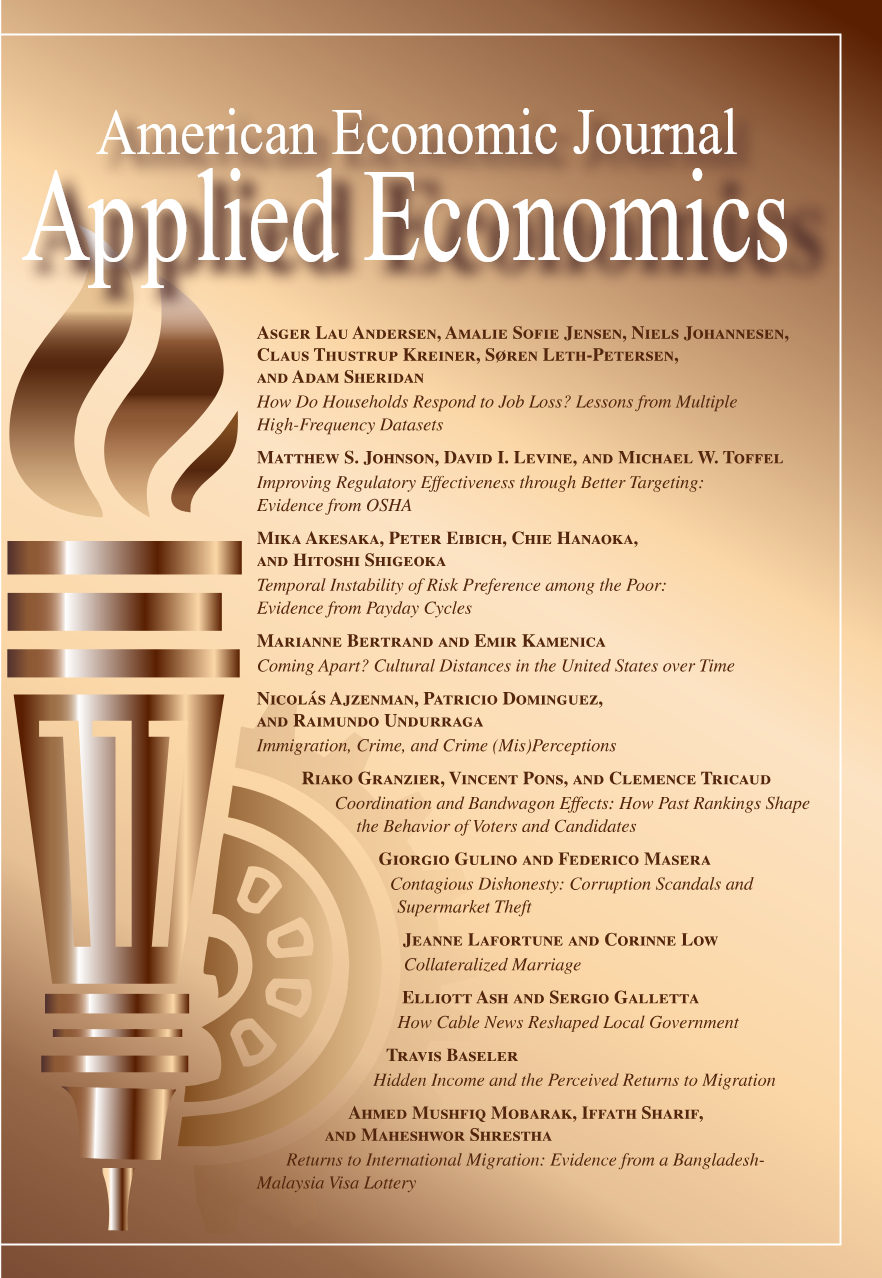
Voice at Work
in: American Economic Journal: Applied Economics, Vol. 17 (3), 2025
Abstract
We estimate the effects of worker voice on productivity, job quality, and separations. We study the 1991 introduction of a right to worker representation on boards or advisory councils in Finnish firms with at least 150 employees, designed primarily to facilitate workforce-management communication. Consistent with information sharing theories, our difference-in-differences design reveals that worker voice slightly raised labor productivity, firm survival, and capital intensity. In contrast to the exit-voice theory, we find no effects on voluntary job separations, and at most small positive effects on other measures of job quality. A 2008 introduction of shop-floor representation had similarly limited effects.
Arbeitspapiere

Identifying Bankruptcies in German Social Security Data
in: FDZ-Methodenreport, Nr. 10, 2017
Abstract
In empirischen Studien über Firmenschließungen wird häufig die Notwendigkeit betont, zwischen verschiedenen Arten von Schließungen, z.B. freiwilligen und unfreiwilligen, zu unterscheiden. Dieser Methodenreport erläutert vor diesem Hintergrund, wie im Betriebs-Historik-Panel (BHP) Betriebsstillegungen aufgrund von Insolvenzen identifiziert werden können. Insolvenzen können im Gegensatz zu anderen Schließungen eindeutig als Ausdruck ökonomischen Scheiterns und somit als unfreiwillige Schließungen interpretiert werden. (Autorenreferat, IAB-Doku)


