
Anpassungsfähigkeit und Resilienz des Finanzsystems
Diese Forschungsgruppe untersucht kritische Aspekte der Anpassungsfähigkeit und Widerstandsfähigkeit von Finanzsystemen. Sie analysiert die Auswirkungen von Naturkatastrophen auf Finanzsysteme, die Auswirkungen politischer Präferenzen für die grüne Transformation und die Bedeutung von Kultur in den Volkswirtschaften.
Forschungscluster
Finanzresilienz und RegulierungIhr Kontakt

- Abteilung Finanzmärkte















PROJEKTE
08.2022 ‐ 07.2025
OVERHANG: Schuldenüberhang und grüne Investitionen – die Rolle von Banken für den klimafreundlichen Umgang mit emissionsintensiven Anlagenvermögen
Bundesministerium für Bildung und Forschung (BMBF)
Ziel von OVERHANG ist es, die Rolle von Banken für den klimafreundlichen Umgang mit emissionsintensiven Anlagevermögen zu untersuchen. Hierdurch sollen politikrelevante Erkenntnisse zu Finanzregulierung, staatlich kontrollierter Kreditvergabe und Finanzstabilität identifiziert sowie eine Sensibilisierung der verschuldeten Akteurinnen und Akteuren erreicht werden.
Das Projekt wird vom Bundesministerium für Bildung und Forschung (BMBF) finanziert.
01.2015 ‐ 12.2019
Interactions between Bank-specific Risk and Macroeconomic Performance
Deutsche Forschungsgemeinschaft (DFG)
07.2016 ‐ 12.2018
Relationship Lenders and Unorthodox Monetary Policy: Investment, Employment, and Resource Reallocation Effects
Leibniz-Gemeinschaft
We combine a number of unique and proprietary data sources to measure the impact of relationship lenders and unconventional monetary policy during and after the European sovereign debt crisis on the real economy. Establishing systematic links between different research data centers (Forschungsdatenzentren, FDZ) and central banks with detailed micro-level information on both financial and real activity is the stand-alone proposition of our proposal. The main objective is to permit the identification of causal effects, or their absence, regarding which policies were conducive to mitigate financial shocks and stimulate real economic activities, such as employment, investment, or the closure of plants.
Referierte Publikationen
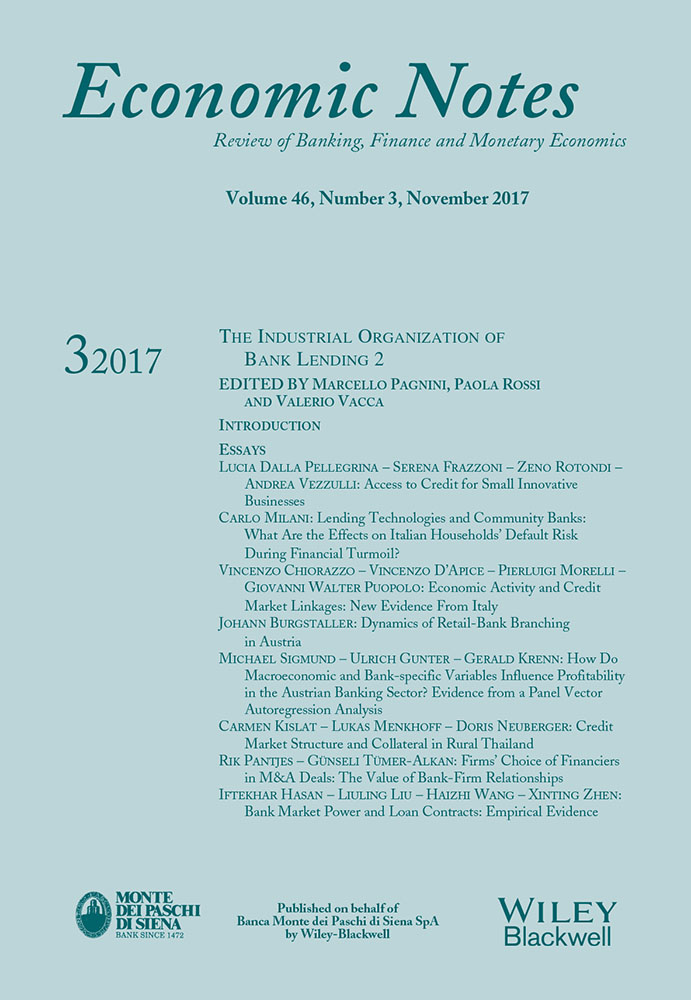
Bank Market Power and Loan Contracts: Empirical Evidence
in: Economic Notes, im Erscheinen
Abstract
Using a sample of syndicated loan facilities granted to US corporate borrowers from 1987 to 2013, we directly gauge the lead banks’ market power, and test its effects on both price and non‐price terms in loan contracts. We find that bank market power is positively correlated with loan spreads, and the positive relation holds for both non‐relationship loans and relationship loans. In particular, we report that, for relationship loans, lending banks charge lower loan price for borrowing firms with lower switching cost. We further employ a framework accommodating the joint determination of loan contractual terms, and document that the lead banks’ market power is positively correlated with collateral and negatively correlated with loan maturity. In addition, we report a significant and negative relationship between banking power and the number of covenants in loan contracts, and the negative relationship is stronger for relationship loans.
Political Corruption, Dodd–Frank Whistleblowing, and Debt Financing
in: Journal of Corporate Finance, April 2025
Abstract
<p>We investigate how a state's political corruption affects a resident firm's debt contracting and how a change in anti-corruption regulation alters the relation between corruption and loan contracting. Firms in more corrupt states are associated with significantly higher loan spreads and tighter loan covenants than firms in less corrupt states. Furthermore, the passage of the Dodd–Frank whistleblowing provision amplifies the conhcerns of banks about the detrimental impact of corruption due to the increased exposure of firms to whistleblowing threats. The detrimental impact of corruption is further amplified when a state has a higher level of whistleblowing involvement, when firms are located in more corrupt states or closer to the SEC office, and when the bank's state is less corrupt than the firm's state. In general, we document the externality of corruption in the debt financing of firms and the response of banks to changes in regulation.</p>
Nothing Special about an Allowance for Corporate Equity: Evidence from Italian Banks
in: Journal of International Money and Finance, February 2025
Abstract
<p>This paper analyzes the impact of reduced tax incentives for equity financing on banks' regulatory capital ratios under the Basel III regime. We are particularly interested in a recent interest rate cut in the Italian corporate equity allowance, which reduces the relative tax advantage of equity financing. The results show that banks respond to this increased tax disparity by significantly reducing their regulatory capital while at the same time reducing their risk-taking. The decline in capital is more pronounced for small banks and outweighs the initial capital gains from the introduction of this tax instrument. Our results challenge the use of equity allowances, in that financial stability gains persist only as long as costly tax subsidies remain intact and diminish as the size of the subsidy is reduced.</p>
Church Membership and Economic Recovery: Evidence from the 2005 Hurricane Season
in: Economic Journal, Nr. 664, 2024
Abstract
<p>This paper investigates the critical role of church membership in the process of economic recovery after high-impact natural disasters. We document a significant adverse treatment effect of the 2005 hurricane season in the Southeastern United States on establishment-level productivity. However, we find that establishments in counties with higher rates of church membership saw a significantly stronger recovery in terms of productivity for 2005–10. We also show that church membership is correlated with post-disaster entrepreneurship activities and population growth.</p>

State Ownership and Financial Statement Comparability
in: Journal of Business Finance and Accounting, Nr. 7, 2024
Abstract
<p>This paper investigates how state ownership affects financial reporting practices in China. Using several measures of state (government) ownership, we show that a one-standard-deviation increase in state ownership decreases financial statement comparability by 36.61%, and the impact is more pronounced when the central authority has majority control of the company. Moreover, lower earnings quality and lower levels of accounting conservatism among state-owned enterprises (SOEs) may explain the lower accounting comparability between SOEs and non-SOEs (NSOEs). Additionally, similar (different) managerial objectives converge (diverge) financial statement comparability between SOEs and NSOEs. Last, the geographical locations of firms also contribute to financial statement comparability. We employ a difference-in-differences design, changes regression and entropy balancing to mitigate potential endogeneity bias.</p>
Arbeitspapiere
Corporate Governance Structures and Financial Constraints in Multinational Enterprises – An Analysis in Selected European Transition Economies on the Basis of the IWH FDI Micro Database 2013 –
in: IWH Discussion Papers, Nr. 3, 2015
Abstract
In our analysis, we consider the distribution of decision power over financing and investment between MNEs’ headquarters and foreign subsidiaries and its influence on the foreign affiliates’ financial restrictions. Our research results show that headquarters of multinational enterprises have not (yet) moved much decision power to their foreign subsidiaries at all. We use data from the IWH FDI Micro Database which contains information on corporate governance structures and financial restrictions of 609 enterprises with a foreign investor in Hungary, Poland, the Czech Republic, Slovakia, Romania and East Germany. We match data from Bureau van Dijk’s AMADEUS database on financial characteristics. We find that a high concentration of decision power within the MNE’s headquarter implicates high financial restrictions within the subsidiary. Square term results show, however, that the effect of financial constraints within the subsidiary decreases and finally turns insignificant when decision power moves from headquarter to subsidiary. Thus, economic policy should encourage foreign investors in the case of foreign acquisition of local enterprises to leave decision power within the enterprise and in the case of Greenfield investment to provide the newly established subsidiaries with as much power over corporate governance structures as possible.


