Professor Dr. Felix Noth

Professor Dr. Felix Noth

Aktuelle Position

seit 10/16

Stellvertretender Leiter der Abteilung Finanzmärkte

Leibniz-Institut für Wirtschaftsforschung Halle (IWH)

seit 3/14

Leiter der Forschungsgruppe Anpassungsfähigkeit und Resilienz des Finanzsystems

Leibniz-Institut für Wirtschaftsforschung Halle (IWH)

seit 7/20

Professor für Banken und Finanzsysteme

Otto-von-Guericke-Universität, Magdeburg

Forschungsschwerpunkte

  • Bankenmärkte und realwirtschaftliches Wachstum
  • Bankenregulierung und Risikoanreize für Banken
  • Naturkatastrophen und Auswirkungen auf Banken

Felix Noth ist seit März 2014 Mitglied der Abteilung Finanzmärkte am IWH und Professor für Banken und Finanzsysteme an der Otto-von-Guericke-Universität Magdeburg. Er forscht zu den Themen empirische Bank- und Finanzwirtschaft.

Felix Noth studierte an der Ludwig-Maximilians-Universität München und promovierte an der Goethe-Universität Frankfurt. Bevor er zum IWH kam, war er wissenschaftlicher Assistent an der Goethe-Universität Frankfurt am Main.

Ihr Kontakt

Professor Dr. Felix Noth
- Abteilung Finanzmärkte
Nachricht senden +49 345 7753-702 Persönliche Seite

Publikationen

Zitationen
1545

cover_international-finance.jpg

A Note on the Use of Syndicated Loan Data

Isabella Müller Felix Noth Lena Tonzer

in: International Finance, Vol. 28 (3), 2025

Abstract

Syndicated loan data provided by DealScan is an essential input in banking research to answer urging questions on bank lending, e.g., in the presence of financial or geopolitical shocks or climate change. However, many data options raise the question of how to choose the estimation sample. We employ a standard regression framework analyzing bank lending during the financial crisis of 2007/08 to study how conventional but varying usages of DealScan affect the estimates. The key finding is that the direction of coefficients remains relatively robust. However, statistical significance depends on the data and sampling choice, and we provide guidelines for applied research.

Publikation lesen

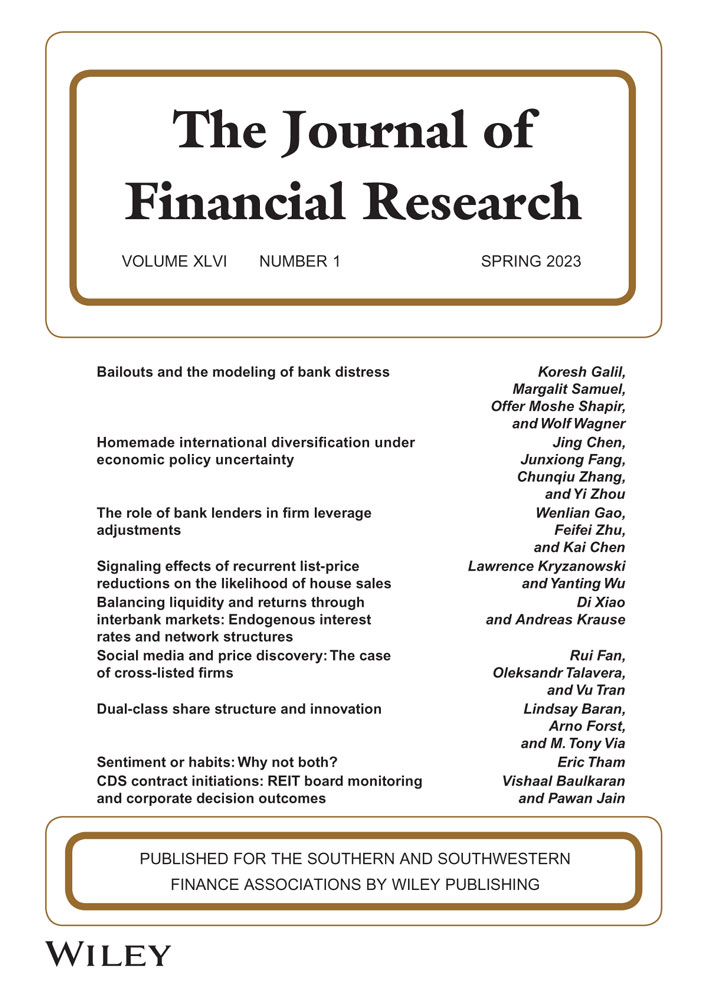
cover_the-journal-of-financial-research.jpg

‘And Forgive Us Our Debts’: Christian Moralities and Over-indebtedness

Iftekhar Hasan Konstantin Kiesel Felix Noth

in: Journal of Financial Research, 2025

Abstract

This paper analyses whether Christian moralities and rules formed differently by Catholics and Protestants impact the likelihood of households to become overindebted. We find that over-indebtedness is lower in regions in which Catholics outweigh Protestants, indicating that Catholics‘ forgiveness culture and a stricter enforcement of rules by Protestants serve as explanations for our results. Our results provide evidence that religion affects the financial situations of individuals and show that even 500 years after the split between Catholics and Protestants, the differences in the mind-sets of both denominations play an important role for situations of severe financial conditions.

Publikation lesen

cover_journal-of-international-money-and-finance.png

Nothing Special about an Allowance for Corporate Equity: Evidence from Italian Banks

Dennis Dreusch Felix Noth Peter Reichling

in: Journal of International Money and Finance, Vol. 150 (February), 2025

Abstract

This paper analyzes the impact of reduced tax incentives for equity financing on banks' regulatory capital ratios under the Basel III regime. We are particularly interested in a recent interest rate cut in the Italian corporate equity allowance, which reduces the relative tax advantage of equity financing. The results show that banks respond to this increased tax disparity by significantly reducing their regulatory capital while at the same time reducing their risk-taking. The decline in capital is more pronounced for small banks and outweighs the initial capital gains from the introduction of this tax instrument. Our results challenge the use of equity allowances, in that financial stability gains persist only as long as costly tax subsidies remain intact and diminish as the size of the subsidy is reduced.

Publikation lesen

Arbeitspapiere

cover_DP_2025-04.jpg

Contractionary Macroprudential Policy, Collateral Valuation, and Risk-shifting in EU Banking

Michael Koetter Felix Noth Fabian Woebbeking

in: IWH Discussion Papers, Nr. 4, 2025

Abstract

We study real estate lending responses to tighter macroprudential policy (MPP) in the form of lower required loan-to-value (LTV) ratios. Contract details of 2.4 million mortgage loans originated between 2008 and 2020 reveal significantly fewer new loan issuances in response to contractionary MPP, commensurate with an average reduction in aggregate lending of 21 percent. Loan-level analyses reveal, however, that banks comply with lower LTVs by systematically more benevolent valuations of residential real estate pledged as collateral instead of reducing loan size. Exploiting earthquakes as plausible exogenous shocks to property values corroborates these risk-shifting patterns by banks in the form of inflated property valuations after LTV shocks.

Publikation lesen

cover_DP_2025-02.jpg

Ecological Preferences and the Carbon Intensity of Corporate Investment

Michael Koetter Felix Noth

in: IWH Discussion Papers, Nr. 2, 2025

Abstract

Lowering carbon intensity in manufacturing is necessary to transform current production technologies. We test if local agents’ preferences, revealed by vote shares for the Green party during local elections in Germany, relate to the carbon intensity of investments in production technologies. Our sample comprises all investment choices made by manufacturing establishments from 2005-2017. Our results suggest that ecological preferences correlate with significantly fewer carbon-intensive investment projects while investments stimulating growth and reducing carbon emissions increase by 14 percentage points. Both results are more distinct in federal states where the Green Party enjoys political power and local ecological preferences are high.

Publikation lesen

cover_DP_2024-23.jpg

From Shares to Machines: How Common Ownership Drives Automation

Joseph Emmens Dennis Hutschenreiter Stefano Manfredonia Felix Noth Tommaso Santini

in: IWH Discussion Papers, Nr. 23, 2024

Abstract

Does increasing common ownership influence firms’ automation strategies? We develop and empirically test a theory indicating that institutional investors’ common ownership drives firms that employ workers in the same local labor markets to boost automation-related innovation. First, we present a model integrating task-based production and common ownership, demonstrating that greater ownership overlap drives firms to internalize the impact of their automation decisions on the wage bills of local labor market competitors, leading to more automation and reduced employment. Second, we empirically validate the model’s predictions. Based on patent texts, the geographic distribution of firms’ labor forces at the establishment level, and exogenous increases in common ownership due to institutional investor mergers, we analyze the effects of rising common ownership on automation innovation within and across labor markets. Our findings reveal that firms experiencing a positive shock to common ownership with labor market rivals exhibit increased automation and decreased employment growth. Conversely, similar ownership shocks do not affect automation innovation if firms do not share local labor markets.

Publikation lesen
Mitglied der Leibniz-Gemeinschaft LogoTotal-Equality-LogoGefördert durch das BMWK