Makroökonomik und natürliche Umwelt
Diese Forschungsgruppe untersucht, wie sich Veränderungen der biologischen Vielfalt, Klimawandel und Umweltpolitik auf das langfristige Wachstum und kurzfristige wirtschaftliche Schwankungen auf aggregierter, regionaler und sektoraler Ebene auswirken.
Forschungscluster
Wirtschaftliche Dynamik und StabilitätIhr Kontakt

- Abteilung Makroökonomik




Referierte Publikationen

A Multi-Model Assessment of Inequality and Climate Change
in: Nature Climate Change, October 2024
Abstract
<p>Climate change and inequality are critical and interrelated defining issues for this century. Despite growing empirical evidence on the economic incidence of climate policies and impacts, mainstream model-based assessments are often silent on the interplay between climate change and economic inequality. For example, all the major model comparisons reviewed in IPCC neglect within-country inequalities. Here we fill this gap by presenting a model ensemble of eight large-scale Integrated Assessment Models belonging to different model paradigms and featuring economic heterogeneity. We study the distributional implications of Paris-aligned climate target of 1.5 degree and include different carbon revenue redistribution schemes. Moreover, we account for the economic inequalities resulting from residual and avoided climate impacts. We find that price-based climate policies without compensatory measures increase economic inequality in most countries and across models. However, revenue redistribution through equal per-capita transfers can offset this effect, leading to on average decrease in the Gini index by almost two points. When climate benefits are included, inequality is further reduced, but only in the long term. Around mid-century, the combination of dried-up carbon revenues and yet limited climate benefits leads to higher inequality under the Paris target than in the Reference scenario, indicating the need for further policy measures in the medium term.</p>
Arbeitspapiere
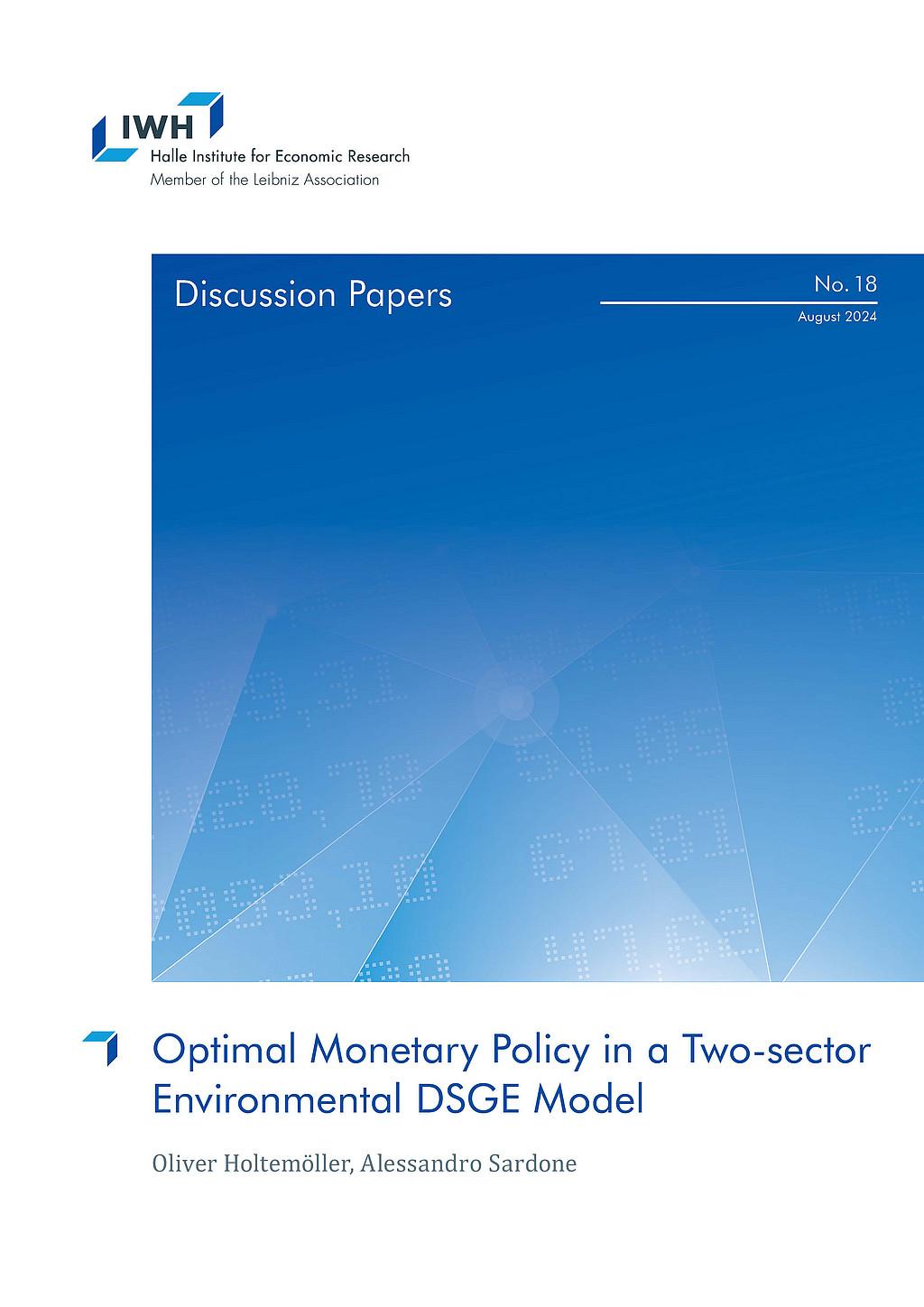
Optimal Monetary Policy in a Two-sector Environmental DSGE Model
in: IWH Discussion Papers, Nr. 18, 2024
Abstract
<p>In this paper, we discuss how environmental damage and emission reduction policies affect the conduct of monetary policy in a two-sector (clean and dirty) dynamic stochastic general equilibrium model. In particular, we examine the optimal response of the interest rate to changes in sectoral inflation due to standard supply shocks, conditional on a given environmental policy. We then compare the performance of a nonstandard monetary rule with sectoral inflation targets to that of a standard Taylor rule. Our main results are as follows: first, the optimal monetary policy is affected by the existence of environmental policy (carbon taxation), as this introduces a distortion in the relative price level between the clean and dirty sectors. Second, compared with a standard Taylor rule targeting aggregate inflation, a monetary policy rule with asymmetric responses to sector-specific inflation allows for reduced volatility in the inflation gap, output gap, and emissions. Third, a nonstandard monetary policy rule allows for a higher level of welfare, so the two goals of welfare maximization and emission minimization can be aligned.</p>

A Multi-Model Assessment of Inequality and Climate Change
in: Research Square, 2024
Abstract
<p>Climate change and inequality are critical and interrelated defining issues for this century. Despite growing empirical evidence on the economic incidence of climate policies and impacts, mainstream model-based assessments are often silent on the interplay between climate change and economic inequality. For example, all the major model comparisons reviewed in IPCC neglect within-country inequalities. Here we fill this gap by presenting a model ensemble of eight large-scale Integrated Assessment Models belonging to different model paradigms and featuring economic heterogeneity. We study the distributional implications of Paris-aligned climate target of 1.5 degree and include different carbon revenue redistribution schemes. Moreover, we account for the economic inequalities resulting from residual and avoided climate impacts. We find that price-based climate policies without compensatory measures increase economic inequality in most countries and across models. However, revenue redistribution through equal per-capita transfers can offset this effect, leading to on average decrease in the Gini index by almost two points. When climate benefits are included, inequality is further reduced, but only in the long term. Around mid-century, the combination of dried-up carbon revenues and yet limited climate benefits leads to higher inequality under the Paris target than in the Reference scenario, indicating the need for further policy measures in the medium term.</p>