Marius Fourné

Marius Fourné
Aktuelle Position

seit 10/21

Wissenschaftlicher Mitarbeiter der Abteilung Makroökonomik

Leibniz-Institut für Wirtschaftsforschung Halle (IWH)

Forschungsschwerpunkte

  • Klimapolitik
  • internationaler Handel
  • Einkommensverteilung

Marius Fourné ist seit Oktober 2021 Doktorand in der Abteilung Makroökonomik. Er forscht zu den Themen internationaler Handel, Einkommensverteilung und Klimaschutzpolitik.

Marius Fourné studierte an der Universität Trier.

Ihr Kontakt

Marius Fourné
Marius Fourné
- Abteilung Makroökonomik
Nachricht senden +49 345 7753-860 Persönliche Seite

Arbeitspapiere

cover_DP_2025-19.jpg

Cross-border Transmission of Climate Policies Through Global Production Networks

Marius Fourné

in: IWH Discussion Papers, Nr. 19, 2025

Abstract

Climate policies do not operate in isolation but propagate through global production networks, affecting industries beyond national borders. This paper combines international input-output data with a granular instrumental variable approach to capture how foreign regulations transmit through upstream and downstream linkages. Distinguishing between market-based policies, non-market regulations, and technology support, the analysis shows that foreign climate policies can enhance domestic productivity, with effects shaped by industry characteristics and operating through technological adjustment along supply chains. The results underscore the importance of accounting for international spillovers when evaluating the economic impact of environmental regulation.

Publikation lesen

cover_DP_2024-20.jpg

Climate Policy and International Capital Reallocation

Marius Fourné Xiang Li

in: IWH Discussion Papers, Nr. 20, 2024

Abstract

This study employs bilateral data on external assets to examine the impact of climate policies on the reallocation of international capital. We find that the stringency of climate policy in the destination country is significantly and positively associated with an increase in the allocation of portfolio equity and banking investment to that country. However, it does not show significant effects on the allocation of foreign direct investment and portfolio debt. Our findings are not driven by valuation effects, and we present evidence that suggests diversification, suasion, and uncertainty mitigation as possible underlying mechanisms.

Publikation lesen

cover_DP_2022-7.jpg

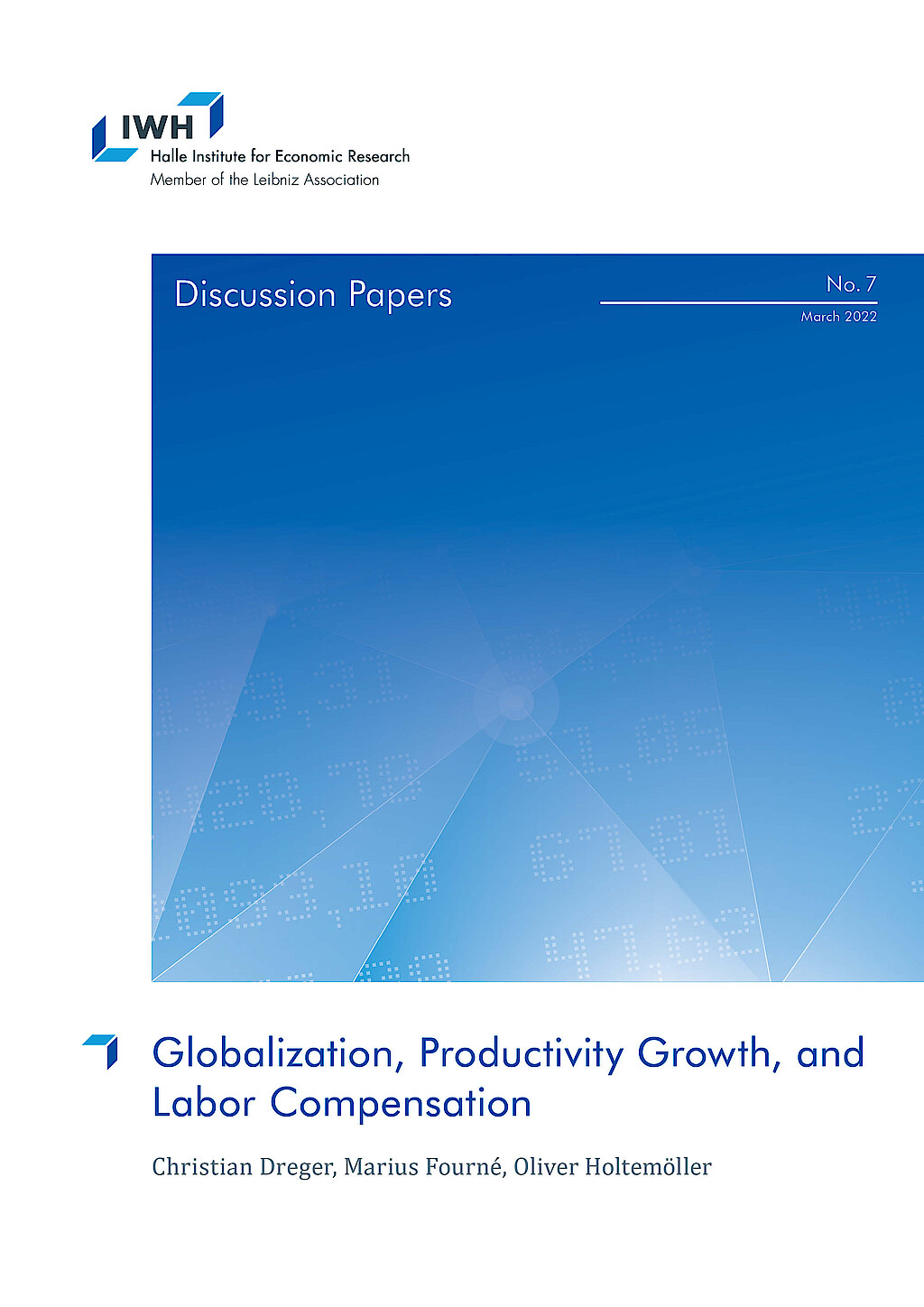
Globalization, Productivity Growth, and Labor Compensation

Christian Dreger Marius Fourné Oliver Holtemöller

in: IWH Discussion Papers, Nr. 7, 2022

Abstract

Since the onset of globalization, production activities have become increasingly fragmented and organized in global value chains, facilitating the trade of intermediaries across industries and countries. In this paper, we analyze the dynamic effect of increasing participation in global value chains on both productivity growth and the functional income distribution. To account for potential endogeneity, we construct a granular instrumental variable for international trade integration using detailed international input-output tables. Our findings show on the country-industry level, that both trade in intermediate inputs and trade in value-added significantly raise productivity in advanced countries, at the expense of the labor share of income. Moreover, labor shares decline more sharply in both manufacturing and services sectors, as well as in industries positioned closer to the final stages of the global value chain. Finally, our results show that a decline in international trade integration would have substantial negative effects on long-term productivity growth.

Publikation lesen
Mitglied der Leibniz-Gemeinschaft LogoTotal-Equality-LogoGefördert durch das BMWK