
Dr. Eva Dettmann

Dr. Eva Dettmann
Aktuelle Position

seit 3/18

Stellvertretende Leiterin des Zentrums für evidenzbasierte Politikberatung (IWH-CEP)

Leibniz-Institut für Wirtschaftsforschung Halle (IWH)

Forschungsschwerpunkte

  • Evaluation von Regional- und Innovationspolitik
  • Wirksamkeit wirtschaftspolitischer Instrumente
  • angewandte Mikroökonometrie

Eva Dettmann ist seit 2002 wissenschaftliche Mitarbeiterin und seit 2018 die stellvertretende Leiterin des Zentrums für evidenzbasierte Politikberatung (IWH-CEP). Zu ihren Forschungsschwerpunkten zählen mikroökonometrische Analysen, insbesondere die Evaluation wirtschaftspolitischer Entscheidungen.

Eva Dettmann studierte und promovierte an der Martin-Luther-Universität Halle-Wittenberg.

Ihr Kontakt

Dr. Eva Dettmann
Dr. Eva Dettmann
- Abteilung Zentrum für evidenzbasierte Politikberatung
Nachricht senden +49 345 7753-855

Publikationen

Zitationen
483

cover_regional-studies.jpg

Employment Effects of Investment Grants and Firm Heterogeneity

Eva Dettmann Antje Weyh Mirko Titze

in: Regional Studies, im Erscheinen

Abstract

<p>This study estimates the firm-level employment effects of investment grants in Germany. In addition to the average treatment effect on the treated, we examine discrimination in the funding rules as a potential source of effect heterogeneity. We combine a staggered difference-in-differences approach with a matching procedure at the cohort level. The findings reveal a positive effect of investment grants on employment development. The subsample analyses yield strong evidence for heterogeneous effects based on firm characteristics and the economic environment. They highlight the responsibility of the local funding authorities to clarify ex ante which goals of a funding programme are most important in their regions.</p>

Publikation lesen

cover_regional-science-and-urban-economics.jpg

The Regional Effects of a Place-based Policy – Causal Evidence from Germany

Matthias Brachert Eva Dettmann Mirko Titze

in: Regional Science and Urban Economics, November 2019

Abstract

The German government provides discretionary investment grants to structurally weak regions in order to reduce regional inequality. We use a regression discontinuity design that exploits an exogenous discrete jump in the probability of regional actors to receive investment grants to identify the causal effects of the policy. We find positive effects of the programme on district-level gross value-added and productivity growth, but no effects on employment and gross wage growth.

Publikation lesen

cover_regional-studies.jpg

The Impact of Innovation and Innovation Subsidies on Economic Development in German Regions

Uwe Cantner Eva Dettmann Alexander Giebler Jutta Günther Maria Kristalova

in: Regional Studies, Nr. 9, 2019

Abstract

Public innovation subsidies in a regional environment are expected to unfold a positive economic impact over time. The focus of this paper is on an assessment of the long-run impact of innovation and innovation subsidies in German regions. This is scrutinized by an estimation approach combining panel model and time-series characteristics and using regional data for the years 1980–2014. The results show that innovation and innovation subsidies in the long run have a positive impact on the economic development of regions in Germany. This supports a long-term strategy for regional and innovation policy.

Publikation lesen

Arbeitspapiere

cover_DP_2025-18.jpg

A Helping Hand, but not a Lift. EU Cohesion Policy and Regional Development

Eva Dettmann Sarah Fritz

in: IWH Discussion Papers, Nr. 18, 2025

Abstract

<p>This study provides new evidence on the impact of the EU Cohesion Policy on income growth in less developed regions. Our panel includes data from all European regions for the years 1989-2020. Using a fuzzy Regression Discontinuity Design, we model treatment dynamics by applying a random effects estimator. Based on digitized historical data, we precisely replicate the policy rule and correctly classify the regions’ eligibility status. Results show that the policy has a moderate positive effect on GDP per capita growth in the targeted regions.</p>

Publikation lesen

cover_DP_2025-12.jpg

Investment Grants: Curse or Blessing for Employment?

Eva Dettmann

in: IWH Discussion Papers, Nr. 12, 2025

Abstract

<p>In this study, establishment-level employment effects of investment grants in Germany are estimated. In addition to the quantitative effects, I provide empirical evidence of funding effects on different aspects of employment quality (earnings, qualifications, and job security) for the period 2004 to 2020. The database combines project-level treatment data, establishment-level information on firm characteristics and employee structure, and regional information at the district-level. For the estimations, I combine the difference-in-differences approach of Callaway and Sant’Anna (2021) with ties matching at the cohort level. The estimations yield positive effects on the number of employees, but point to contradicting effects of investment grants on different aspects of employment quality.</p>

Publikation lesen

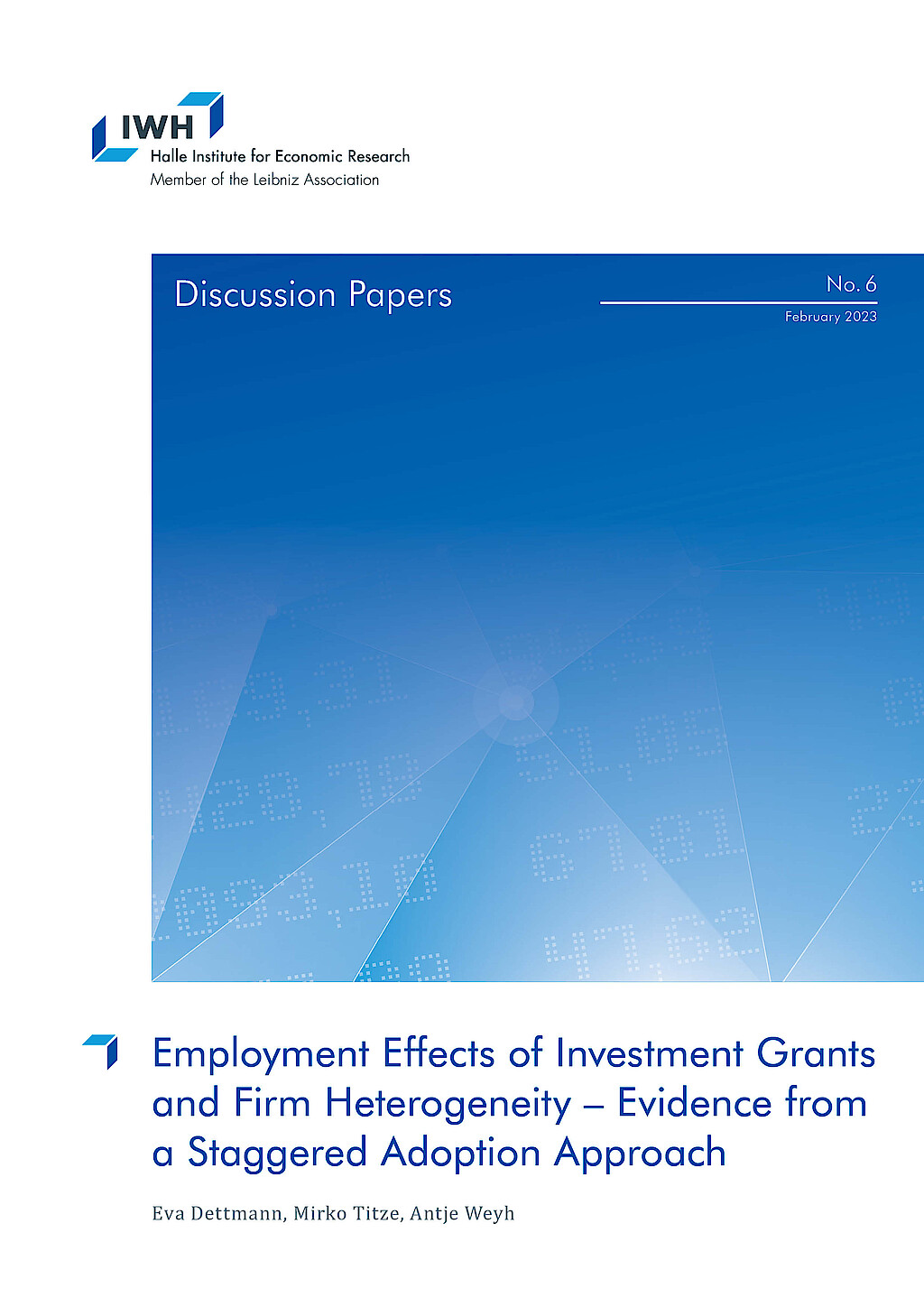
cover_DP_2023-6.jpg

Employment Effects of Investment Grants and Firm Heterogeneity – Evidence from a Staggered Adoption Approach

Eva Dettmann Mirko Titze Antje Weyh

in: IWH Discussion Papers, Nr. 6, 2023

Abstract

<p>This study estimates the firm-level employment effects of investment grants in Germany. In addition to the average treatment effect on the treated, we examine discrimination in the funding rules as potential source of effect heterogeneity. We combine a staggered difference-in-differences approach that explicitly models variations in treatment timing with a matching procedure at the cohort level. The findings reveal a positive effect of investment grants on employment development in the full sample. The subsample analysis yields strong evidence for heterogeneous effects based on firm characteristics and the economic environment. This can help to improve the future design of the program.</p>

Publikation lesen
Mitglied der Leibniz-Gemeinschaft LogoTotal-Equality-LogoGefördert durch das BMWK