Professor Xiang Li, PhD

Professor Xiang Li, PhD

Current Position

since 4/25

Associate Professor of International Macroeconomics

Leipzig University

and

Senior Research Advisor of the Department Macroeconomics

Halle Institute for Economic Research (IWH) – Member of the Leibniz Association

since 1/19

Head of the Research Group Financial Integration, Economic Growth and Financial Stability

Halle Institute for Economic Research (IWH) – Member of the Leibniz Association

since 10/18

Member of the Department Macroeconomics

Halle Institute for Economic Research (IWH) – Member of the Leibniz Association

Research Interests

  • international finance
  • Chinese economy
  • open economy macroeconomics

Xiang Li is a member of the Department of Macroeconomics at IWH since October 2018 and Associate Professor of International Macroeconomics at Leipzig University since April 2025. Her research focuses on the question of what role multinational companies play in the transmission of global financial shocks. Xiang Li is one of eight female scientists across Germany who are being funded in the Leibniz Professorship Programme 2024. This programme supports internationally outstanding female scientists from all disciplines.

Xiang Li received her two bachelor's degrees and her PhD from Peking University. She was Assistant Professor at Martin Luther University Halle-Wittenberg from 2018 to 2024 in a joint appointment with IWH.

Your contact

Professor Xiang Li, PhD
- Department Macroeconomics
Send Message +49 345 7753-805 Personal page

Publications

Citations
333

cover_journal-of-financial-stability.jpg

Climate Policy and International Capital Reallocation

Marius Fourné Xiang Li

in: Journal of Financial Stability, Vol. 82 (February), 2026

Abstract

This study employs bilateral data on external assets to examine the impact of climate policies on the reallocation of international capital. We find that the stringency of climate policy in the destination country is significantly and positively associated with an increase in the allocation of portfolio equity and banking investment to that country. However, it does not show significant effects on the allocation of foreign direct investment and portfolio debt. Our findings are not driven by valuation effects, and we present evidence that suggests diversification, suasion, and uncertainty mitigation as possible underlying mechanisms.

read publication

cover_finance-research-letters_nov2019.png

Geopolitical Tensions And Multinational Brands: Evidence From China

Rongyu Cui Xiang Li

in: Finance Research Letters, Vol. 85 (November), 2025

Abstract

Using brand-level sales data from Chinese e-commerce platforms, this study examines how geopolitical tensions affect multinational brands operating in China. Merging these sales data with a U.S.–China tension index, we use panel regressions and local projections to show that rising tensions significantly reduce the market share of U.S. brands in China relative to brands from other countries, with the effects persisting for up to 12 months. An event study employing a difference-in-differences framework, centered on brand-specific incidents of political tension with China, reveals similar market share declines among affected brands, highlighting consumer sentiment as a key transmission channel.

read publication

cover_european-economic-review.jpg

Financial Technologies and the Effectiveness of Monetary Policy Transmission

Iftekhar Hasan Boreum Kwak Xiang Li

in: European Economic Review, Vol. 161 (January), 2024

Abstract

This study investigates whether and how financial technologies (FinTech) influence the effectiveness of monetary policy transmission. We use an interacted panel vector autoregression model to explore how the effects of monetary policy shocks change with regional-level FinTech adoption. Results indicate that FinTech adoption generally mitigates the transmission of monetary policy to real GDP, consumer prices, bank loans, and housing prices, with the most significant impact observed in the weakened transmission to bank loan growth. The relaxed financial constraints, regulatory arbitrage, and intensified competition are the possible mechanisms underlying the mitigated transmission.

read publication

Working Papers

cover_DP_2025-08.jpg

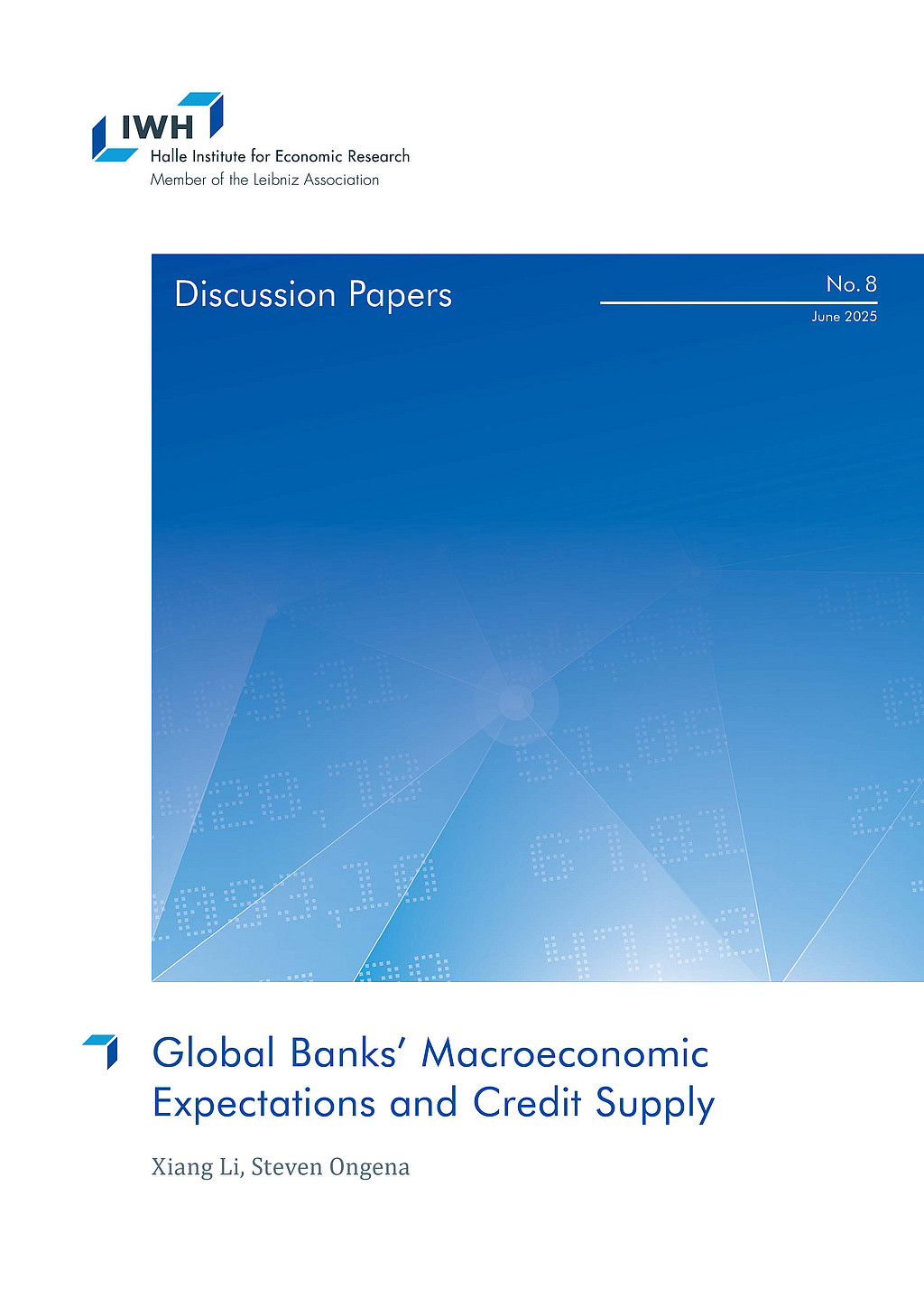
Global Banks’ Macroeconomic Expectations and Credit Supply

Xiang Li Steven Ongena

in: IWH Discussion Papers, No. 8, 2025

Abstract

We investigate how global banks’ macroeconomic expectations for borrower countries influence their credit supply. Utilizing granular data on varying expectations among banks lending to the same firm at the same time, combined with an instrumental variable approach, we find that more optimistic GDP growth expectations for a borrower country are strongly linked to increased credit supply. Specifically, a one standard deviation increase in a lender’s GDP growth expectation for the borrower’s country corresponds to an increase of 8.46 percentage points in the loan share, equivalent to approximately 0.75 standard deviations of the loan share and $75.35 million in loan amount. In contrast, global banks’ short-term inflation expectations do not show a significant impact on their credit supply.

read publication

cover_DP_2023-23.jpg

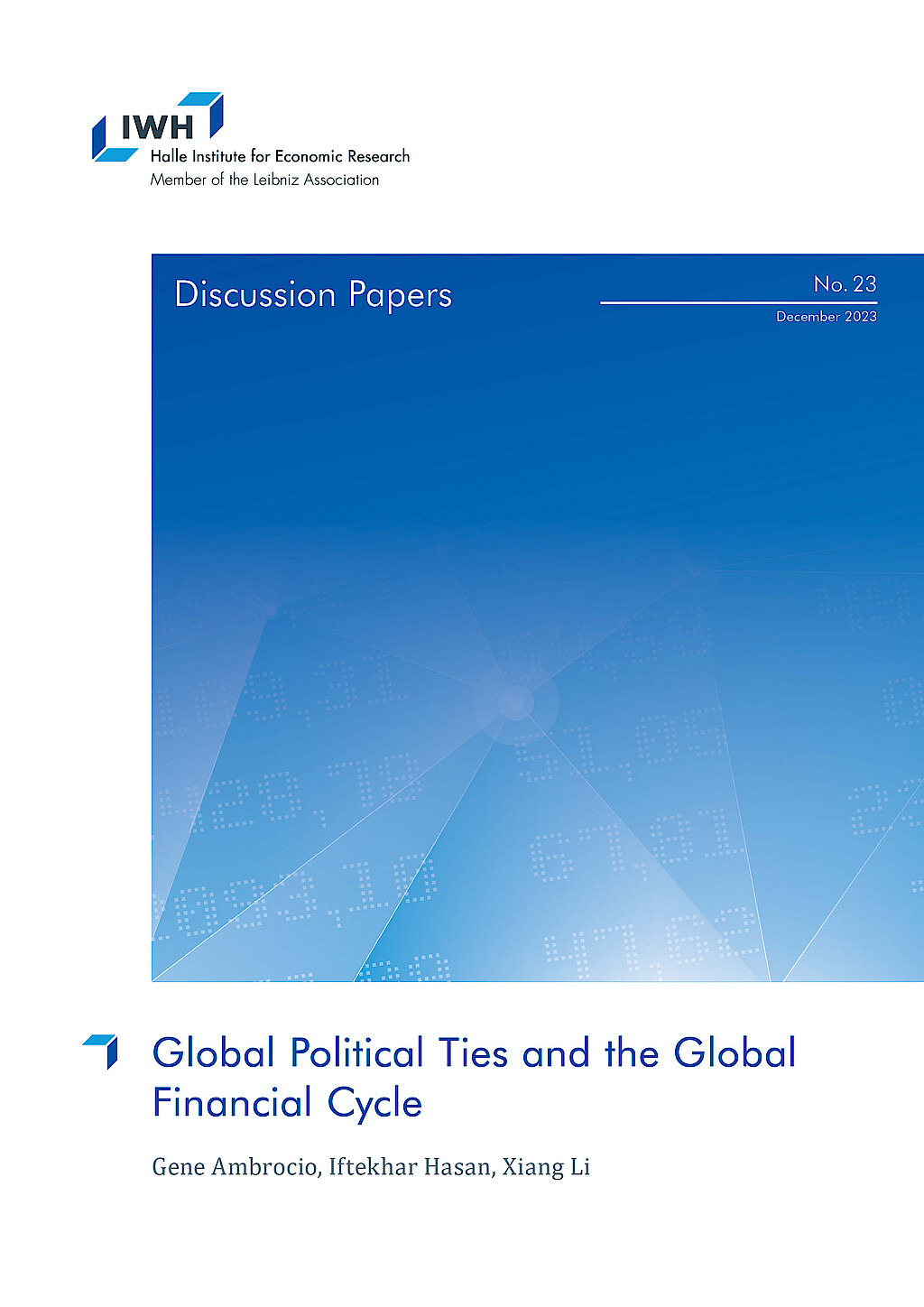
Global Political Ties and the Global Financial Cycle

Gene Ambrocio Iftekhar Hasan Xiang Li

in: IWH Discussion Papers, No. 23, 2023

Abstract

We study the implications of forging stronger political ties with the US on the sensitivities of stock returns around the world to a global common factor – the global financial cycle. Using voting patterns at the United Nations as a measure of political ties with the US along with various measures of the global financial cycle, we document evidence indicating that stronger political ties with the US amplify the sensitivities of stock returns in developing countries to the global financial cycle. We explore several channels and find that a deepening of financial linkages along with a reduction in information asymmetries and an amplification of sentiment are potentially important factors behind this result.

read publication

cover_DP_2022-18.jpg

BigTech Credit, Small Business, and Monetary Policy Transmission: Theory and Evidence

Yiping Huang Xiang Li Han Qiu Dan Su Changhua Yu

in: IWH Discussion Papers, No. 18, 2022

Abstract

This paper provides both theoretical and empirical analyses of the differences between BigTech lenders and traditional banks in response to monetary policy changes. Our model integrates Knightian uncertainty into portfolio selection and posits that BigTech lenders possess a diminishing informational advantage with increasing firm size, resulting in reduced ambiguity when lending to smaller firms. The model suggests that the key distinction between BigTech lenders and traditional banks in response to shifts in funding costs, triggered by monetary policy changes, is more evident at the extensive margin rather than the intensive margin, particularly during periods of easing monetary policy. Using a micro-level dataset of small business loans from both types of lenders, we provide empirical support for our theoretical propositions. Our results show that BigTech lenders are more responsive in establishing new lending relationships in an easing monetary policy environment, while the differences in loan amounts are not statistically significant. We also discuss other loan terms and the implications of regulatory policies.

read publication
Mitglied der Leibniz-Gemeinschaft LogoTotal-Equality-LogoSupported by the BMWK