
Financial System Adaptability and Resilience
Financial systems differ across countries and tend to evolve slowly over time. Their structure is typically stable, but their resilience is often tested. A well-functioning financial system is vital for economic development, as it ensures that capital flows to the most productive and valuable investment opportunities. However, systemic vulnerabilities can have far-reaching consequences. For example, the 2007–08 global financial crisis emerged from within the financial sector itself when complex financial products fuelled a credit bubble in the U.S. housing market, threatening global economic stability when the bubble burst. That event led to extensive policy and regulatory reforms to strengthen financial system resilience.
Financial systems continue to face significant challenges. External shocks like the COVID-19 pandemic, the climate crisis, the green economic transition, and the energy crisis driven by geopolitical conflict all underscore the importance of financial systems that can absorb shocks and adapt to changing economic conditions. Motivated by these pressing issues, we investigate how financial systems respond to crises, which institutions and policies improve resilience, and the role of finance systems' setup in broader economic transformations. We use diverse data sources, including bank and firm-level data, regulatory reports, and house price and election data, to inform evidence-based policy.
Research Cluster
Financial Resilience and RegulationYour contact

- Department Financial Markets















EXTERNAL FUNDING
08.2022 ‐ 07.2025
OVERHANG: Debt overhang and green investments - the role of banks in climate-friendly management of emission-intensive fixed assets
The collaborative project “Debt Overhang and Green Investments” (OVERHANG) aims to investigate the role of banks in the climate-friendly management of emission-intensive fixed assets. This will identify policy-relevant insights on financial regulation, government-controlled lending and financial stability, as well as raise awareness among indebted stakeholders.
01.2015 ‐ 12.2019
Interactions between Bank-specific Risk and Macroeconomic Performance
07.2016 ‐ 12.2018
Relationship Lenders and Unorthodox Monetary Policy: Investment, Employment, and Resource Reallocation Effects
Leibniz Association
We combine a number of unique and proprietary data sources to measure the impact of relationship lenders and unconventional monetary policy during and after the European sovereign debt crisis on the real economy. Establishing systematic links between different research data centers (Forschungsdatenzentren, FDZ) and central banks with detailed micro-level information on both financial and real activity is the stand-alone proposition of our proposal. The main objective is to permit the identification of causal effects, or their absence, regarding which policies were conducive to mitigate financial shocks and stimulate real economic activities, such as employment, investment, or the closure of plants.
Refereed Publications
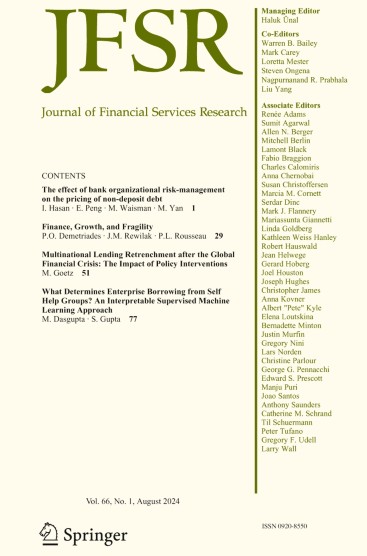
The Impact of Bank and Non-bank Financial Institutions on Local Economic Growth in China
in: Journal of Financial Services Research, No. 2, 2010
Abstract
This paper provides evidence on the relationship between finance and growth in a fast growing country, such as China. Employing data of 27 Chinese provinces over the period 1995–2003, we study whether the financial development of two different types of financial institutions — banks and non-banks — have a (significantly different) impact on local economic growth. Our findings indicate that banking development shows a statistically significant and economically more pronounced impact on local economic growth.
Cross-border Exposures and Financial Contagion
in: International Review of Finance, No. 2, 2010
Abstract
Integrated financial markets provide opportunities for expansion and improved risk sharing, but also pose threats of contagion risk through cross-border exposures. This paper examines cross-border contagion risk over the period 1999–2006. To that purpose we use aggregate cross-border exposures of 17 countries as reported in the Bank for International Settlements Consolidated Banking Statistics. We find that a shock that affects the liabilities of one country may undermine the stability of the entire financial system. Particularly, a shock wiping out 25% (35%) of US (UK) cross-border liabilities against non-US (non-UK) banks could lead to bank contagion eroding at least 94% (45%) of the recipient countries' banking assets. We also find that since 2006 a shock to Eastern Europe, Turkey and Russia affects most countries. Our simulations also reveal that the ‘speed of propagation of contagion’ has increased in recent years resulting in a higher number of directly exposed banking systems. Finally, we find that contagion is more widespread in geographical proximities.

Lending Technology, Bank Organization and Competition
in: Journal of Financial Transformation, 2009
Abstract
This paper reviews recent theoretical and empirical studies investigating how both bank technology and organization shape bank-borrower interactions. We refer to two related concepts for bank technology. First, the technologies banks employ in loan granting decisions and second, the advances in information technology linked to the bank's lending technology. We also summarize and interpret the theoretical and empirical work on bank organization and its influence on lending technologies. We show that the choice of lending technology and bank organization depend heavily on the availability of information, the technological progress in the collection of information, as well as the banking market structure and the legal environment. We draw important policy conclusions from the literature. Competition authorities and supervisors have to remain alert to the consequences of the introduction of any new technology because: (1) advances in technology do not necessarily lead to more intense banking competition, and (2) the impact of technological and financial innovation on financial efficiency and stability depends on the incentives of the entire „loan production chain.‟
The Impact of Organizational Structure and Lending Technology on Banking Competition
in: Review of Finance, No. 2, 2009
Abstract
We investigate how bank organization shapes banking competition. We show that a bank's geographical lending reach and loan pricing strategy is determined by its own and its rivals’ organizational structure. We estimate the impact of organization on the geographical reach and loan pricing of a large bank. We find that the reach of the bank is smaller when rival banks are large and hierarchically organized, have superior communication technology, have a narrower span of organization, and are closer to a decision unit with lending authority. Rival banks’ size and the number of layers to a decision unit soften spatial pricing.
Dynamic Order Submission Strategies with Competition between a Dealer Market and a Crossing Network
in: Journal of Financial Economics, No. 3, 2009
Abstract
We analyze a dynamic microstructure model in which a dealer market (DM) and a crossing network (CN) interact for three informational settings. A key result is that coexistence of trading systems generates systematic patterns in order flow, which depend on the degree of transparency. Further, we study overall welfare, measured by the gains from trade of all agents, and compare it with the maximum overall welfare. The discrepancy between both measures is attributable to two inefficiencies. Due to these inefficiencies, introducing a CN next to a DM, as well as increasing the transparency level, not necessarily produces greater overall welfare.
Working Papers

Ecological Preferences and the carbon Intensity of Corporate Investment
in: IWH Discussion Papers, No. 2, 2025
Abstract
<p>Lowering carbon intensity in manufacturing is necessary to transform current production technologies. We test if local agents’ preferences, revealed by vote shares for the Green party during local elections in Germany, relate to the carbon intensity of investments in production technologies. Our sample comprises all investment choices made by manufacturing establishments from 2005-2017. Our results suggest that ecological preferences correlate with significantly fewer carbon-intensive investment projects while investments stimulating growth and reducing carbon emissions increase by 14 percentage points. Both results are more distinct in federal states where the Green Party enjoys political power and local ecological preferences are high.</p>
Green Investing, Information Asymmetry, and Capital Structure
in: IWH Discussion Papers, No. 20, 2023
Abstract
We investigate how optimal attention allocation of green-motivated investors changes information asymmetry in financial markets and thus affects firms‘ financing costs. To guide our empirical analysis, we propose a model where investors with heterogeneous green preferences endogenously allocate limited attention to learn market-level or firm-specific fundamental shocks. We find that a higher fraction of green investors in the market leads to higher aggregate attention to green firms. This reduces the information asymmetry of green firms, leading to higher price informativeness and lower leverage. Moreover, the information asymmetry of brown firms and the market increases with the share of green investors. Therefore, greater green attention is associated with less market efficiency. We provide empirical evidence to support our model predictions using U.S. data. Our paper shows how the growing demand for sustainable investing shifts investors‘ attention and benefits eco-friendly firms.
Long-run Competitive Spillovers of the Credit Crunch
in: IWH Discussion Papers, No. 10, 2023
Abstract
Competition in the U.S. appears to have declined. One contributing factor may have been heterogeneity in the availability of credit during the financial crisis. I examine the impact of product market peer credit constraints on long-run competitive outcomes and behavior among non-financial firms. I use measures of lender exposure to the financial crisis to create a plausibly exogenous instrument for product market credit availability. I find that credit constraints of product market peers positively predict growth in sales, market share, profitability, and markups. This is consistent with the notion that firms gained at the expense of their credit constrained peers. The relationship is robust to accounting for other sources of inter-firm spillovers, namely credit access of technology network and supply chain peers. Further, I find evidence of strategic investment, i.e. the idea that firms increase investment in response to peer credit constraints to commit to deter entry mobility. This behavior may explain why temporary heterogeneity in the availability of credit appears to have resulted in a persistent redistribution of output across firms.
Banking Market Deregulation and Mortality Inequality
in: Bank of Finland Research Discussion Papers, No. 14, 2022
Abstract
This paper shows that local banking market conditions affect mortality rates in the United States. Exploiting the staggered relaxation of branching restrictions in the 1990s across states, we find that banking deregulation decreases local mortality rates. This effect is driven by a decrease in the mortality rate of black residents, implying a decrease in the black-white mortality gap. We further analyze the role of mortgage markets as a transmitter between banking deregulation and mortality and show that households' easier access to finance explains mortality dynamics. We do not find any evidence that our results can be explained by improved labor outcomes.
A Note on the Use of Syndicated Loan Data
in: IWH Discussion Papers, No. 17, 2022
Abstract
<p>Syndicated loan data provided by DealScan is an essential input in banking research. This data is rich enough to answer urging questions on bank lending, e.g., in the presence of financial shocks or climate change. However, many data options raise the question of how to choose the estimation sample. We employ a standard regression framework analyzing bank lending during the financial crisis of 2007/08 to study how conventional but varying usages of DealScan affect the estimates. The key finding is that the direction of coefficients remains relatively robust. However, statistical significance depends on the data and sampling choice and we provide guidelines for applied research.</p>


