Dr. Götz Zeddies

Aktuelle Position

seit 12/05

Wissenschaftlicher Mitarbeiter der Abteilung Makroökonomik

Leibniz-Institut für Wirtschaftsforschung Halle (IWH)

Forschungsschwerpunkte

  • Konjunkturanalyse und -prognose
  • Prognose der öffentlichen Finanzen für Deutschland
  • Mitglied im Arbeitskreis "Steuerschätzungen" beim Bundesministerium der Finanzen

Götz Zeddies ist seit 2005 in der Abteilung Makroökonomik tätig. Er forscht auf dem Gebiet Steuerföderalismus.

Götz Zeddies hat an der Universität Hohenheim studiert und promovierte an der Georg-August-Universität Göttingen.

Ihr Kontakt

Dr. Götz Zeddies
- Abteilung Makroökonomik
Nachricht senden +49 345 7753-854

Publikationen

Neueste Publikationen

cover_iwh-pn_2025-03_de.jpg

Wirkung der Verwendung der Mittel des Sondervermögens Infrastruktur und Klimaneutralität sowie der zusätzlichen Bundesmittel für Verteidigung, Zivil- und Bevölkerungsschutz auf das Potenzialwachstum in Mecklenburg-Vorpommern

Andrej Drygalla Katja Heinisch Oliver Holtemöller Axel Lindner Christoph Schult Anna Solms Götz Zeddies

in: IWH Policy Notes, Nr. 3, 2025

Abstract

<p><strong>Schriftliche Anhörung des Finanzausschusses des Landtags Mecklenburg-Vorpommern</strong></p> <p>Welche Wachstumsimpulse können zusätzliche, kreditfinanzierte Finanzmittel für Infrastruktur, Klimaneutralität und Verteidigung in Mecklenburg-Vorpommern setzen? Im Rahmen einer schriftlichen Anhörung des Finanzausschusses des Landtages Mecklenburg-Vorpommern beantwortet das IWH Fragen zur Verwendung der Finanzmittel und zur möglichen Wirkung von zusätzlichen Investitionen auf das Produktionspotenzial und das Wirtschaftswachstum in Mecklenburg-Vorpommern. Angesichts der demographischen Entwicklung ist die Arbeitsproduktivität der Schlüssel zur Verbesserung der Wachstumsaussichten des Landes.</p>

Publikation lesen

cover_policy_notes_02_2025.jpg

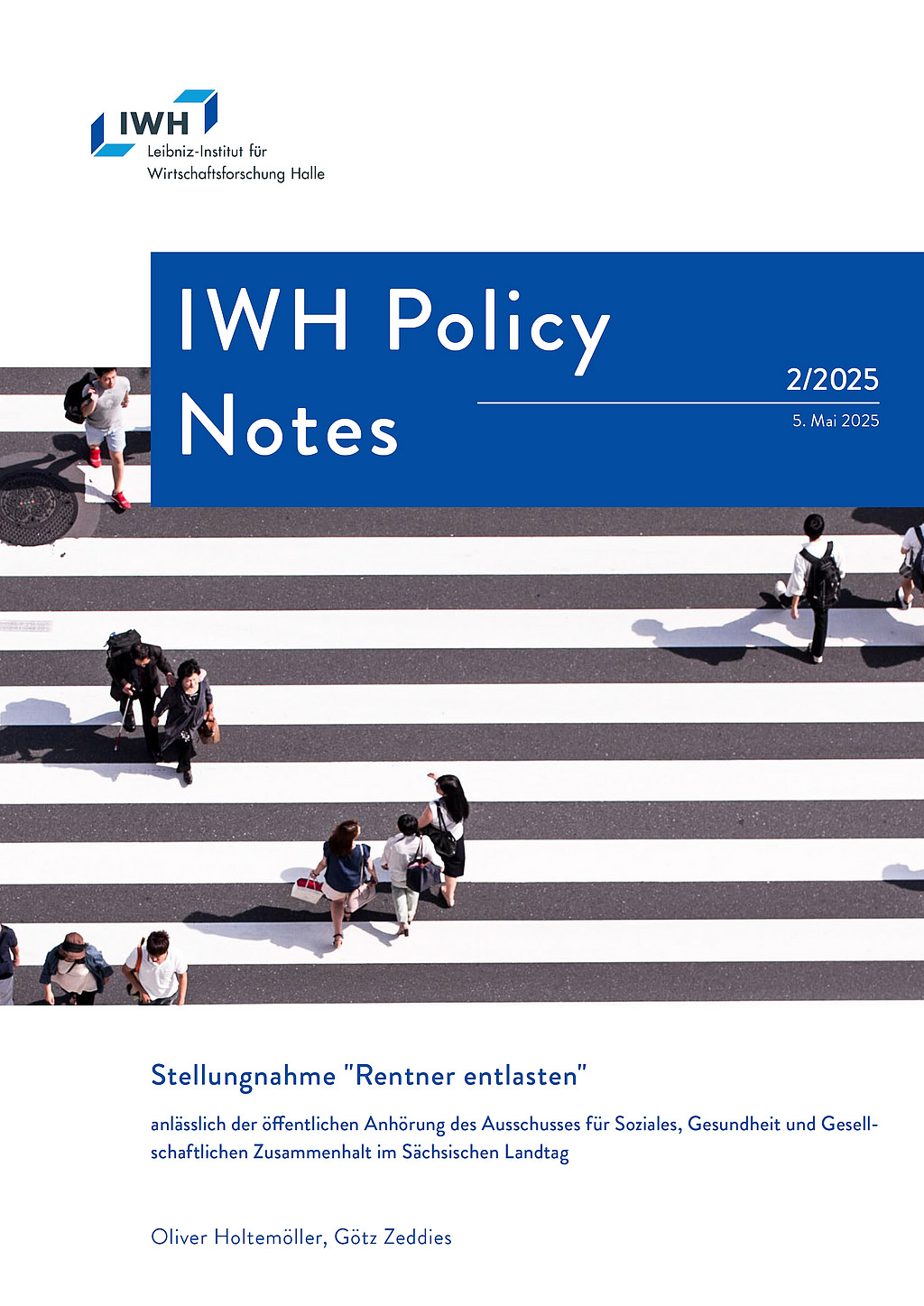
Stellungnahme "Rentner entlasten" anlässlich der öffentlichen Anhörung des Ausschusses für Soziales, Gesundheit und Gesellschaftlichen Zusammenhalt im Sächsischen Landtag

Oliver Holtemöller Götz Zeddies

in: IWH Policy Notes, Nr. 2, 2025

Abstract

<p>Mit Antrag vom 11. März 2025 fordert die BSW-Fraktion im Sächsischen Landtag, gesetzliche Renten bis zu einer Höhe von 2.000 Euro im Monat steuerlich freizustellen, um die hohen Preissteigerungen der vergangenen Jahre für diese Personengruppe auszugleichen. Ein Blick auf die Einkommenssituation von Rentnern und Arbeitnehmern zeigt allerdings, dass ein Fokus allein auf die gesetzliche Rente zu kurz greift, weil Rentnerhaushalte im Durchschnitt über weitere Einnahmequellen verfügen. Zudem müssten die Einnahmeausfälle gegenfinanziert werden, wodurch andere gesellschaftliche Gruppen zusätzlich belastet würden. Schließlich würde die steuerliche Freistellung von niedrigen und mittleren Renteneinkommen deren Empfänger gegenüber Arbeitnehmern besserstellen. Auch die Arbeitsanreize für Ältere würden gemindert. Mit der Grundsicherung im Alter steht ein zielgenaueres Instrument zur Unterstützung bedürftiger Haushalte zur Verfügung.</p>

Publikation lesen

cover_Konjunktur_aktuell_2024-4.jpg

Mittelfristige Projektion der gesamtwirtschaftlichen Entwicklung und Szenarien für die Erreichung der gesetzlichen Emissionsziele

Andrej Drygalla Katja Heinisch Oliver Holtemöller Axel Lindner Alessandro Sardone Christoph Schult Götz Zeddies

in: Konjunktur aktuell, Nr. 4, 2024

Abstract

<p>Das Produktionspotenzial der deutschen Wirtschaft wächst mittelfristig (2023 bis 2029) mit einer jahresdurchschnittlichen Rate von 0,3% und damit deutlich schwächer als in den Jahren zuvor. Dies ist auf eine ungünstigere Entwicklung aller drei Faktoren (Arbeitsvolumen, Kapitalstock, totale Faktorproduktivität) zurückzuführen. Das potenzielle Wachstum wird insbesondere durch den Rückgang der durchschnittlichen Arbeitszeit gedämpft.</p>

Publikation lesen


Referierte Publikationen

cover_zeitschrift-fuer-wirtschaftspolitik.jpg

Zu den rentenpolitischen Plänen im Koalitionsvertrag 2018 von CDU, CSU und SPD: Konsequenzen, Finanzierungsoptionen und Reformbedarf

Oliver Holtemöller Christoph Schult Götz Zeddies

in: Zeitschrift für Wirtschaftspolitik, Nr. 3, 2018

Abstract

In the coalition agreement from February 7, 2018, the new German federal government drafts its public pension policy, which has to be evaluated against the background of demographic dynamics in Germany. In this paper, the consequences of public pensions related policy measures for the German public pension insurance are illustrated using a simulation model. In the long run, the intended extensions of benefits would lead to an increase in the contribution rate to the German public pension insurance of about two and a half percentage points. Referring to pension systems of other countries, we discuss measures in order to limit this increase in the contribution rate.

Publikation lesen

cover_intereconomics.jpg

On the Distribution of Refugees in the EU

Oliver Holtemöller Axel Lindner Andreas Schmalzbauer Götz Zeddies

in: Intereconomics, Nr. 4, 2016

Abstract

The current situation regarding the migration of refugees can only be handled efficiently through closer international cooperation in the field of asylum policy. From an economic point of view, it would be reasonable to distribute incoming refugees among all EU countries according to a distribution key that reflects differences in the costs of integration in the individual countries. An efficient distribution would even out the marginal costs of integrating refugees. In order to reach a political agreement, the key for distributing refugees should be complemented by compensation payments that distribute the costs of integration among countries. The key for distributing refugees presented by the EU Commission takes account of appropriate factors in principle, but it is unclear in terms of detail. The compensation payments for countries that should take relatively high numbers of refugees for cost efficiency reasons should be financed by reallocating resources within the EU budget.&nbsp;

Publikation lesen

cover_european_journal_of_comparative_economics.jpg

Skill Content of Intra-european Trade Flows

Götz Zeddies

in: European Journal of Comparative Economics, Nr. 1, 2013

Abstract

In recent decades, the international division of labor has expanded rapidly in the wake of European integration. In this context, especially Western European high-wage countries should have specialized on (human-)capital intensively manufactured goods and should have increasingly sourced labor-intensively manufactured goods, especially parts and components, from Eastern European low wage countries. Since this should be beneficial for the high-skilled and harmful to the lower-qualified workforce in high-wage countries, the opening up of Eastern Europe is often considered as a vital reason for increasing unemployment of the lower-qualified in Western Europe. This paper addresses this issue by analyzing the skill content of Western European countries’ bilateral trade using input-output techniques in order to evaluate possible effects of international trade on labor demand. Thereby, differences in factor inputs and production technologies have been considered, allowing for vertical product differentiation. In this case, skill content of bilateral exports and imports partially differs substantially, especially in bilateral trade between Western and Eastern European countries. According to the results, East-West trade should be harmful particularly to the medium-skilled in Western European countries.

Publikation lesen

Arbeitspapiere

cover_DP_2016-29.jpg

Bracket Creeps: Bane or Boon for the Stability of Numerical Budget Rules?

Martin Altemeyer-Bartscher Götz Zeddies

in: IWH Discussion Papers, Nr. 29, 2016

Abstract

As taxpayers typically pay low attention to a small inflation-induced bracket creep of the income tax, policy-makers tend to postpone its correction into the future. However, the fiscal illusion fades away and political pressure for a tax relief arises since after some years the cumulative increase of the average tax rate exceeds a critical threshold. Using Germany as an example, this paper shows that bracket creeps can provoke revenue cycles in public budgets hindering governments’ compliance with the numerical budget rules. An indexation of the tax tariff could prevent such fluctuations and thus provides a favourable framework for the debt rule.

Publikation lesen

Cover_IWH-Discussion-Papers_2016.jpg

Corporate Taxation and Firm Location in Germany

Götz Zeddies

in: IWH Discussion Papers, Nr. 2, 2015

Abstract

German Fiscal Federalism is characterized by a high degree of fiscal equalization which lowers the efficiency of local tax administration. Currently, a reform of the fiscal equalization scheme is on the political agenda. One option is to grant federal states the right to raise surtaxes on statutory tax rates set by the central government in order to reduce the equalization rate. In such an environment, especially those federal states with lower economic performance would have to raise comparatively high surtaxes. With capital mobility, this could further lower economic performance and thus tax revenues. Although statutory tax rates are so far identical across German federal states, corporate tax burden differs for several reasons. This paper tries to identify the impact of such differences on firm location. As can be shown, effective corporate taxation did seemingly not have a significant impact on firm location across German federal states.

Publikation lesen

Cover_IWH-Discussion-Papers_2016.jpg

Determinants of International Fragmentation of Production in the European Union

Götz Zeddies

in: IWH Discussion Papers, Nr. 15, 2007

Abstract

The last decades were characterized by large increases in world trade, not only in absolute terms, but also in relation to world GDP. This was in large parts caused by increasing exchanges of parts and components between countries as a consequence of international fragmentation of production. Apparently, greater competition especially from the Newly Industrializing and Post-Communist Economies prompted firms in ‘high-wage’ countries to exploit international factor price differences in order to increase their international competitiveness. However, theory predicts that, beside factor price differences, vertical disintegration of production should be driven by a multitude of additional factors. Against this background, the present paper reveals empirical evidence on parts and components trade as an indicator for international fragmentation of production in the European Union. On the basis of a panel data approach, the main explanatory factors for international fragmentation of production are determined. The results show that, although their influence can not be neglected, factor price differences are only one out of many causes for shifting production to or sourcing components from foreign countries.

Publikation lesen
Mitglied der Leibniz-Gemeinschaft LogoTotal-Equality-LogoGefördert durch das BMWK