Dr. Axel Lindner

Dr. Axel Lindner
Aktuelle Position

seit 1/10

Stellvertretender Leiter der Abteilung Makroökonomik

Leibniz-Institut für Wirtschaftsforschung Halle (IWH)

seit 1/13

Leiter der Forschungsgruppe Makroökonomische Analysen und Prognosen

Leibniz-Institut für Wirtschaftsforschung Halle (IWH)

Forschungsschwerpunkte

  • monetäre Ökonomik
  • Konjunktur und Wachstum im Euroraum

Axel Lindner ist seit 2001 am Institut und seit 2010 stellvertretender Leiter der Abteilung Makroökonomik. Seine Forschungsschwerpunkte liegen auf der europäischen Konjunkturanalyse und auf dem Gebiet des Einsatzes der Informationsökonomik bei der Konjunkturprognose. Axel Lindner ist am Institut als Ombudsperson für die Einhaltung der Regeln guter wissenschaftlicher Praxis verantwortlich.

Axel Lindner studierte und promovierte an der Ludwig-Maximilians-Universität München. Nach Aufenthalten als Gastprofessor an der Concordia University in Montreal, Kanada und als Gastwissenschaftler an der Queen's University in Kingston, Kanada, unterrichtete er am Lehrstuhl für Wirtschaftstheorie an der Goethe-Universität Frankfurt.

Ihr Kontakt

Dr. Axel Lindner
Dr. Axel Lindner
- Abteilung Makroökonomik
Nachricht senden +49 345 7753-703

Publikationen

Neueste Publikationen

cover_iwh-pn_2026-01_de.jpg

Einhaltung der EU-Fiskalregeln erfordert umfangreiche Konsolidierung — Mittelfristige Projektion der gesamtwirtschaftlichen Entwicklung und der öffentlichen Finanzen in Deutschland

Andrej Drygalla Katja Heinisch Oliver Holtemöller Axel Lindner Christoph Schult Götz Zeddies

in: IWH Policy Notes, Nr. 1, 2026

Abstract

Der Beitrag untersucht die mittelfristige Entwicklung der deutschen Wirtschaft und der öffentlichen Finanzen vor dem Hintergrund der seit 2025 geltenden neuen EU-Fiskalregeln und der jüngsten Lockerung der nationalen Schuldenbremse. Im Mittelpunkt steht die Frage, ob und unter welchen Bedingungen Deutschland die europäischen Vorgaben zu Defizit, Schuldenstand und Nettoprimärausgaben einhalten kann.

Publikation lesen

cover_flash_2025q4-2026q1.JPG

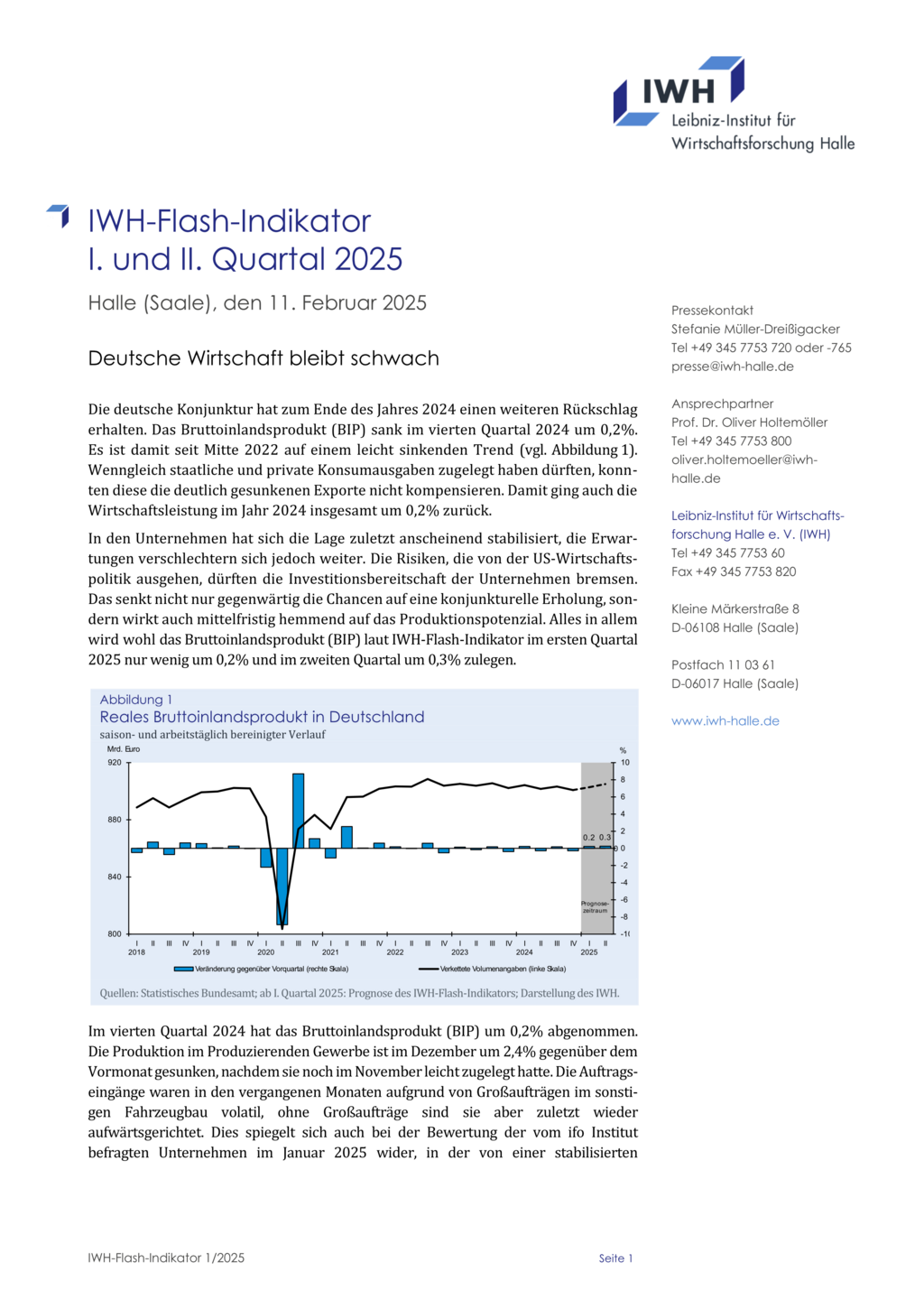
IWH-Flash-Indikator IV. Quartal 2025 und I. Quartal 2026

Katja Heinisch Oliver Holtemöller Axel Lindner Birgit Schultz

in: IWH-Flash-Indikator, Nr. 4, 2025

Abstract

Die deutsche Wirtschaft stagnierte im dritten Quartal 2025, nachdem sie im Quartal zuvor noch um 0,2% geschrumpft war. Einem Rückgang der Exporte standen steigende Investitionen in Ausrüstungen gegenüber. Das Bruttoinlandsprodukt (BIP) liegt damit weiterhin mehr als einen Prozentpunkt unter dem Höchstwert von vor drei Jahren. Die anhaltende Exportschwäche der deutschen Industrie ist dabei nicht auf eine ungünstige weltwirtschaftliche Lage zurückzuführen, sondern auf weiterhin ungelöste strukturelle Probleme wie zu hohe Energie- und Arbeitskosten in Deutschland. Zwar deutet sich zum Jahreswechsel 2025/2026 eine moderate konjunkturelle Belebung an (vgl. Abbildung 1), von den geplanten Mehrausgaben für Verteidigung und Infrastruktur sind jedoch erst ab dem kommenden Jahr konjunkturelle Impulse zu erwarten. Allerdings belasten weltweite Spannungen die Lieferketten weiterhin, und sie führen in der stark arbeitsteiligen deutschen Industrie immer wieder zu Engpässen. Laut IWH-Flash-Indikator steigt das Bruttoinlandsprodukt (BIP) im vierten Quartal 2025 um 0,2% und im ersten Quartal 2026 um 0,4%.

Publikation lesen

cover_iwh-pn_2025-03_de.jpg

Wirkung der Verwendung der Mittel des Sondervermögens Infrastruktur und Klimaneutralität sowie der zusätzlichen Bundesmittel für Verteidigung, Zivil- und Bevölkerungsschutz auf das Potenzialwachstum in Mecklenburg-Vorpommern

Andrej Drygalla Katja Heinisch Oliver Holtemöller Axel Lindner Christoph Schult Anna Solms Götz Zeddies

in: IWH Policy Notes, Nr. 3, 2025

Abstract

Schriftliche Anhörung des Finanzausschusses des Landtags Mecklenburg-Vorpommern

Welche Wachstumsimpulse können zusätzliche, kreditfinanzierte Finanzmittel für Infrastruktur, Klimaneutralität und Verteidigung in Mecklenburg-Vorpommern setzen? Im Rahmen einer schriftlichen Anhörung des Finanzausschusses des Landtages Mecklenburg-Vorpommern beantwortet das IWH Fragen zur Verwendung der Finanzmittel und zur möglichen Wirkung von zusätzlichen Investitionen auf das Produktionspotenzial und das Wirtschaftswachstum in Mecklenburg-Vorpommern. Angesichts der demographischen Entwicklung ist die Arbeitsproduktivität der Schlüssel zur Verbesserung der Wachstumsaussichten des Landes.

Publikation lesen


Referierte Publikationen

cover_applied-economics-letters.jpg

For How Long Do IMF Forecasts of World Economic Growth Stay Up-to-date?

Katja Heinisch Axel Lindner

in: Applied Economics Letters, Vol. 26 (3), 2019

Abstract

This study analyses the performance of the International Monetary Fund (IMF) World Economic Outlook output forecasts for the world and for both the advanced economies and the emerging and developing economies. With a focus on the forecast for the current year and the next year, we examine the durability of IMF forecasts, looking at how much time has to pass so that IMF forecasts can be improved by using leading indicators with monthly updates. Using a real-time data set for GDP and for indicators, we find that some simple single-indicator forecasts on the basis of data that are available at higher frequency can significantly outperform the IMF forecasts as soon as the publication of the IMF’s Outlook is only a few months old. In particular, there is an obvious gain using leading indicators from January to March for the forecast of the current year.

Publikation lesen

cover_intereconomics.jpg

On the Risk of a Sovereign Debt Crisis in Italy

Oliver Holtemöller Tobias Knedlik Axel Lindner

in: Intereconomics, Vol. 53 (6), 2018

Abstract

The intention for the Italian government to stimulate business activity via large increases in government spending is not in line with the stabilisation of the public debt ratio. Instead, if such policy were implemented, the risk of a sovereign debt crisis would be high. In this article, we analyse the capacity of the Italian economy to shoulder sovereign debt under different scenarios. We conclude that focusing on growth enhancing structural reforms, would allow for moderate increases in public expenditure.

Publikation lesen

cover_intereconomics.jpg

On the Distribution of Refugees in the EU

Oliver Holtemöller Axel Lindner Andreas Schmalzbauer Götz Zeddies

in: Intereconomics, Vol. 51 (4), 2016

Abstract

The current situation regarding the migration of refugees can only be handled efficiently through closer international cooperation in the field of asylum policy. From an economic point of view, it would be reasonable to distribute incoming refugees among all EU countries according to a distribution key that reflects differences in the costs of integration in the individual countries. An efficient distribution would even out the marginal costs of integrating refugees. In order to reach a political agreement, the key for distributing refugees should be complemented by compensation payments that distribute the costs of integration among countries. The key for distributing refugees presented by the EU Commission takes account of appropriate factors in principle, but it is unclear in terms of detail. The compensation payments for countries that should take relatively high numbers of refugees for cost efficiency reasons should be financed by reallocating resources within the EU budget. 

Publikation lesen

Arbeitspapiere

cover_DP_2021-15.jpg

Economic Sentiment: Disentangling Private Information from Public Knowledge

Katja Heinisch Axel Lindner

in: IWH Discussion Papers, Nr. 15, 2021

Abstract

This paper addresses a general problem with the use of surveys as source of information about the state of an economy: Answers to surveys are highly dependent on information that is publicly available, while only additional information that is not already publicly known has the potential to improve a professional forecast. We propose a simple procedure to disentangle the private information of agents from knowledge that is already publicly known for surveys that ask for general as well as for private prospects. Our results reveal the potential of our proposed technique for the usage of European Commissions‘ consumer surveys for economic forecasting for Germany.

Publikation lesen

Cover_IWH-Discussion-Papers_2016.jpg

Outperforming IMF Forecasts by the Use of Leading Indicators

Katja Drechsel Sebastian Giesen Axel Lindner

in: IWH Discussion Papers, Nr. 4, 2014

Abstract

This study analyzes the performance of the IMF World Economic Outlook forecasts for world output and the aggregates of both the advanced economies and the emerging and developing economies. With a focus on the forecast for the current and the next year, we examine whether IMF forecasts can be improved by using leading indicators with monthly updates. Using a real-time dataset for GDP and for the indicators we find that some simple single-indicator forecasts on the basis of data that are available at higher frequency can significantly outperform the IMF forecasts if the publication of the Outlook is only a few months old.

Publikation lesen

Cover_IWH-Discussion-Papers_2016.jpg

Evaluating communication strategies for public agencies: transparency, opacity, and secrecy

Axel Lindner

in: IWH Discussion Papers, Nr. 8, 2008

Abstract

This paper analyses in a simple global games framework welfare effects stemming

from different communication strategies of public agencies if strategies of agents are complementary to each other: communication can either be fully transparent, or the agency opaquely publishes only its overall assessment of the economy, or it keeps information completely secret. It is shown that private agents put more weight to their private information in the transparent case than in case of opacity. Thus, in many cases, the appropriate measure against overreliance on public information is giving more details to the public instead of denying access to public information.

Publikation lesen
Mitglied der Leibniz-Gemeinschaft LogoTotal-Equality-LogoGefördert durch das BMWK